Social media tool comparison, sorted by what you cannot undo
Feature grids are built to look equal. Sort the differences by which ones you can walk back.
Two tabs, two feature grids, forty rows each, and both products have a tick in almost every row. An hour later the shortlist has not moved, because feature grids are built to look equal. Nothing on either page tells you which of the two decisions you can walk back in six months and which one you are stuck with until the contract ends.
This is the frame behind every social media tool comparison in this cluster: sort the differences by what you cannot undo. Features move every quarter and can be waited out. Architecture, pricing shape and data ownership cannot.
TL;DR
| Difference | Cost of being wrong | Reversible |
|---|---|---|
| A missing feature | Wait a quarter, or work around it | Yes |
| The interface | Somebody complains for a month | Yes |
| Pricing shape | The bill grows on the wrong axis | At renewal |
| What it can read | Half your questions stay unanswerable | Never |
| Who owns the history | You lose the record when access ends | Never |
Three questions that settle most head to heads
Run these before opening either feature grid. In most pairs one product answers all three the same way as the other, and the comparison is genuinely about taste. When they differ, the difference is the decision.
- What does it need to be given? A tool that writes to an account has to hold that account's keys. That single fact decides which accounts it can ever cover, and no roadmap changes it.
- What does the bill grow with? Channels, seats or tracked accounts. Pick the axis that grows slowest in your business, because the other two will surprise you in month nine.
- Where does the history live? If the readings arrive through somebody else's connection, they leave when that connection does.
A feature you are missing is a quarter of annoyance. An architecture you are wrong about is the whole contract.
First, check the two are in the same category
Half the comparisons people run are between products that do not compete. They are sold with the same words, which is exactly why the grids look so similar, and why the winner never feels obvious.
| If one product | And the other | Then |
|---|---|---|
| Publishes and replies | Publishes and replies | A real comparison |
| Publishes | Only reads public profiles | Two jobs, not one |
| Reports connected channels | Benchmarks rivals | Two jobs, not one |
| Listens for mentions | Counts what was published | Two jobs, not one |
The five blocks this market splits into, and which one each familiar name belongs to, are mapped in social media tools for agencies.
Pricing shape beats price, every time
Two products at the same monthly figure can diverge by a factor of three within a year, because they are priced against different things. Buffer is built for scheduling and light engagement across the channels a customer connects, priced per channel, which is a per channel shape. Sprout Social is built for enterprise reporting, social listening and a shared inbox, priced per seat, which is a per seat one.
- Per channel. Grows with how many networks and accounts you publish to. Bounded by what you sell.
- Per seat. Grows with hiring, which is the number you least want coupled to a software bill.
- Per tracked account. Grows with curiosity, and quietly stops you benchmarking.
- Flat. Rare, and worth a lot more than the headline discount somebody is offering you.
Work out what your tenth of whatever-it-counts costs before comparing the first month. That number, not the plan name, is the price.
The one difference that never becomes reversible
Every product reads from one of three places, and this is the line no comparison page draws. Hootsuite is built around scheduling, a unified inbox and paid social, across the accounts a customer connects to it, so connection is its architecture rather than a setup step.
The consequence is not a feature gap. It is a permanent boundary around which accounts can ever appear: a prospect, a competitor or a colleague who posts under their own name will never grant anything. The full map of the three tiers is in best social media analytics tools.
How to read the comparisons in this cluster
- Two products, neither of them ours. Written as a referee: what each is built around, who wins which job, and the one line we would check before signing.
- One of them ours. Written with the bias declared in the open, and with a section that says plainly when the other product is the right buy.
- No prices, ever. Plans move faster than any comparison page is updated, and a stale figure about a named company is worse than no figure. Every page links to the vendor's own.
If you are not comparing two named products but scanning a category, the ranked version of the same market is in best social media analytics tools for agencies.
Five questions for both vendors, in the same email
Send the identical message to each. Comparing two answers to one question tells you more than two demos, and the difference in how quickly they answer is itself information.
- Can I add an account nobody will connect? The answer splits the market in two.
- Which figures on this screen are estimated? Ask for the list in writing.
- What happens to my data when I stop paying? Export format, and how long you keep access.
- What does the tenth of whatever you charge for cost? Not the first.
- What is on your roadmap that would change any of the above? Usually nothing, which is the useful part.
None of the five is about features, and that is deliberate. The answers you cannot change later are the only ones a comparison should turn on.
What a trial cannot show you
Every difference that matters is invisible during a two week trial, because a trial has one account, two people and no history. That is not a trap laid by vendors, it is arithmetic: the things that separate two products only appear at scale and over time.
| Difference | Visible in a trial |
|---|---|
| The interface | Yes, immediately |
| Whether a feature exists | Yes |
| What the tenth account costs | No |
| What a year of history looks like | No |
| What support answers on a bad day | No |
| What leaving costs | No |
So spend the trial on the top two rows, which it answers well, and get the bottom four in writing from the vendor. A company that answers those four precisely is telling you something a demo cannot.
When the answer is both, and how to split them
A surprising number of head to heads end with two purchases rather than one, and that is not a failure to decide. It happens whenever the two products sit on different sides of the connection line, because then they were never substitutes.
- Split by what is written to. One tool holds the accounts you post from. Anything you only read belongs elsewhere.
- Split by who reads the output. An operator tool and a reporting tool overlap on paper and almost never in practice.
- Never split the same job in two. Two schedulers is a rota nobody maintains, and it is how a post goes out twice.
The sentence for the procurement form, when somebody asks why two: one operates the accounts we publish from, the other covers every account we do not, and the second set is most of what our clients ask about.
Where Groowth sits in all this
Groowth reads public profiles and nothing else. You paste a handle on TikTok, Instagram, YouTube or LinkedIn, it reads that profile once a day, and it counts what was published against the cadence each account agreed to hold.
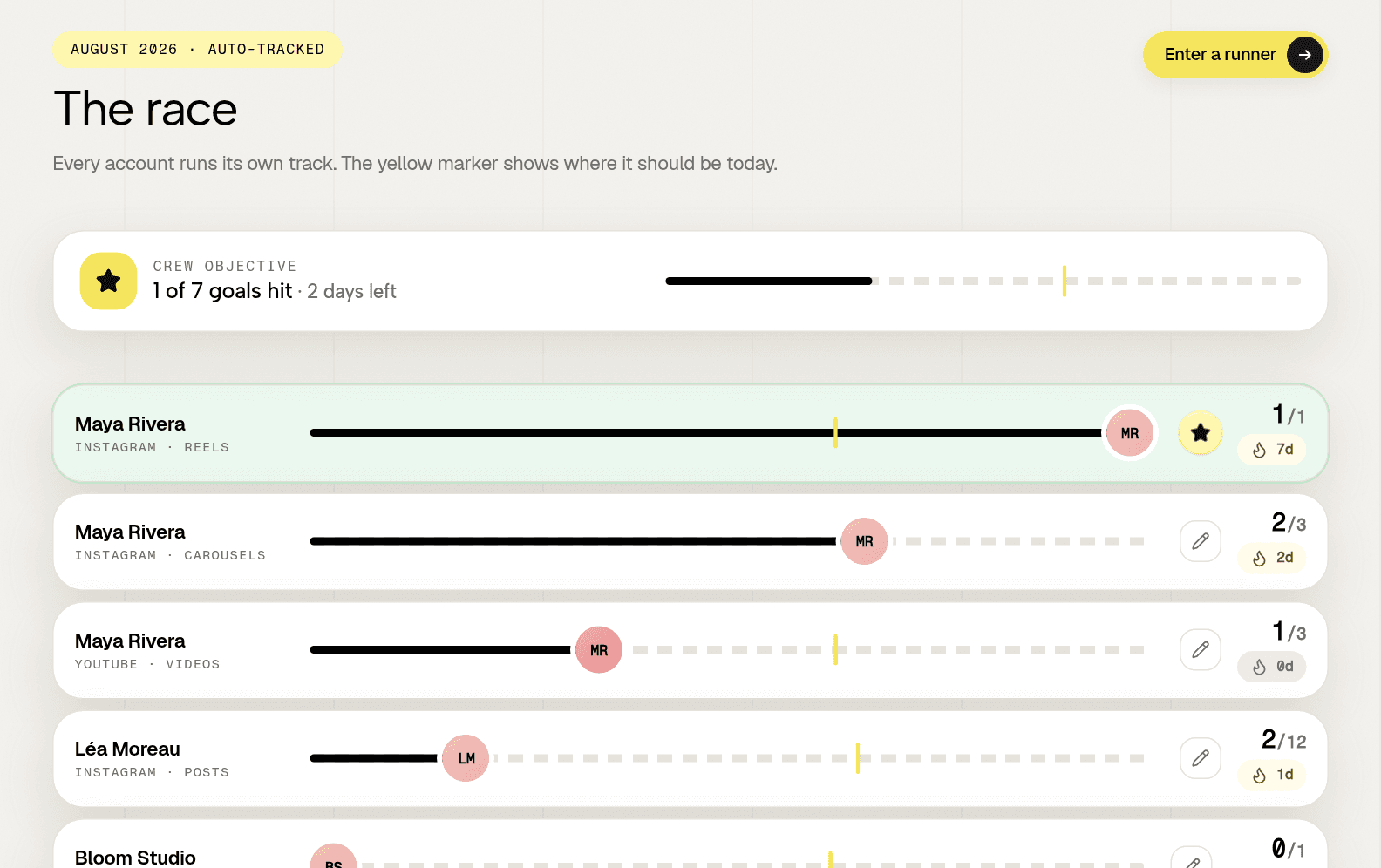
By the three questions above: it needs nothing granted, the bill does not grow per seat, and the readings stay on your side. It also does not publish, does not schedule, has no inbox and never shows reach, so against a suite it is a different job rather than a cheaper one. Three accounts free with no card.
Frequently asked questions
How should you compare two social media tools?
Sort the differences by what you cannot undo. A missing feature costs a quarter of annoyance, while what a tool is allowed to read and who owns the history are permanent, and neither appears on a feature grid.
Why do feature comparisons never settle anything?
Because both grids are written to look complete, so nearly every row has a tick on both sides. What separates the two products is architecture, pricing shape and data ownership, and none of the three is a row on that grid.
What is the single most decisive question?
Whether it can add an account nobody will connect. A tool that writes to accounts must hold their keys, which permanently excludes prospects, competitors and anyone posting under their own name.