Best social media analytics tools, sorted by what they can see
Every ranking compares features. The only line that never moves is what each tool is allowed to read.
Twenty tabs open, and every list ranks the same dozen products in a different order. Not one of them says why one tool can show you reach and the next one cannot. That is not a feature gap you can close with a better plan. It is a difference in what each product is allowed to read, and it decides which questions you can still answer a year from now.
This page sorts the best social media analytics tools by data access before anything else: connected accounts, public profiles, and modelled estimates. Choose the tier your question lives in, then choose a product inside it. Done in that order, most shortlists collapse from twelve names to two.
TL;DR
| Data tier | What it answers | What it needs |
|---|---|---|
| Connected account | Reach, impressions, audience | The owner's login, per account |
| Public profile | Posts, dates, followers, engagement | A handle, nothing else |
| Modelled estimate | A number shaped like reach | Trust you cannot verify |
| Native, inside the app | Everything, one account at a time | An hour a week of copying |
| A shared spreadsheet | Whatever somebody typed | The team it is measuring |
The three tiers, and why the tier decides the tool
Analytics products look interchangeable on a pricing page because they describe the same outputs: dashboards, reports, benchmarks, alerts. What separates them is where the numbers come from, and there are only three answers.
- Connected data. The account owner signs in and grants access. The tool then reads what the platform gives to an owner, including reach, impressions and audience breakdowns.
- Public data. The tool reads what a logged out visitor sees on a profile: posts, publication dates, follower counts, likes and comments. No grant, so it works on anybody.
- Modelled data. The tool has neither, so it estimates. Sometimes the estimate is good. It is still a model, and a model that is not labelled is a liability in a client deck.
Every argument about which analytics tool is best is really an argument about which of these three tiers your question needs.
The tiers are not a quality ladder. Connected data is richer and narrower. Public data is thinner and universal. The mistake is buying for richness when the job needed universality, which is what happens to nearly every agency shortlist.
Tier one: connected accounts, rich and narrow
This is where the suites live. Hootsuite is built around scheduling, a unified inbox and paid social, across the accounts a customer connects to it, and the connection is not a setup step, it is the architecture. The tool writes to the account, so it has to hold the keys.
What you get is the full picture of accounts you control: impressions, reach, saves, click through, audience by country and job title. What you cannot get is anybody else. A prospect will not connect. A competitor will not connect. A founder who posts from their own phone usually will not either.
| Situation | Connected tier |
|---|---|
| Your own brand page | Perfect fit |
| A client who gave you admin | Perfect fit |
| A client who posts personally | Usually refused |
| A prospect before the pitch | Impossible |
| A competitor | Impossible |
| A client who left | History leaves with them |
That last row is the one nobody prices in. Eighteen months of reporting can live behind a connection that ends the day the retainer does.
Tier two: public profiles, thinner and universal
Public reading is what a logged out visitor sees. Social Blade made the category familiar by looking up the public statistics of a single profile, across several networks, with no account needed. The trade is explicit: you lose reach and impressions, and you gain the ability to include anybody at all.
For a lot of real questions that trade is a bargain. Did the five people who committed to a weekly post actually publish one. Is the competitor gaining followers faster than us. Which of their posts got engagement, and what was it about. None of those need a login. What is readable network by network is mapped in public social media metrics.
The honest limits of the tier belong here too. A profile can be set to private and disappear. Public engagement counts are not reach, and treating them as a proxy without saying so is the same sin as an unlabelled model.
Tier three: modelled numbers, and how to spot one
Benchmarking products sit here more often than they admit. Rival IQ is built for competitive social analytics, benchmarking a brand against a landscape of named rivals, and a landscape of rivals is by definition a landscape of accounts nobody connected. Something has to fill the gaps.
There is nothing wrong with a model. There is a lot wrong with a dashboard that puts a measured figure and an estimated one in the same column with the same styling. Three tells give it away.
- A reach figure for an account you do not own. No platform hands that to a third party. It is derived.
- Suspiciously round audience breakdowns. Demographics for a competitor are inference, not measurement.
- No answer to how. A vendor who cannot describe the method in one sentence is asking you to defend it for them.
The shortlist, by the job rather than the brand
Once the tier is settled, the choice inside it is mostly workflow. Here is where the familiar names actually sit, and where each cluster article picks the argument up.
| The job | Tier you need | Where to read next |
|---|---|---|
| Report on client accounts you operate | Connected | Reporting tools for clients |
| Watch prospects and competitors | Public | Competitor analysis tools |
| Prove a team held its cadence | Public | LinkedIn tools for teams |
| Spend nothing this quarter | Native and public | Free tools |
| Go deep on one network | Both | TikTok, Instagram, YouTube |
| Catch a mention of your name | Neither | Monitoring tools |
The agency version of this argument, with the shortlist written out, is in best social media analytics tools for agencies. The version that costs nothing is in best free social media analytics tools.
The tiers also sit differently on each network, which is why this cluster has a page per platform rather than one page hedging. TikTok publishes the view count under every video. YouTube publishes counts through its own documented API. Instagram publishes least and lets accounts hide what is left. Start with best TikTok analytics tools if that is where your work is.
How to choose, by team shape
- One brand, one team, all accounts yours. Connected tier, and the native apps may genuinely be enough. Buy when the copying costs more than the licence.
- An agency with client accounts. Connected for the ones you operate, public for the ones you do not, and expect to run both.
- A team of individuals posting under their own names. Public tier is the only one that reaches them, because personal profiles are the grant nobody gives.
- Anyone benchmarking. Public tier, plus a rule that every modelled number is labelled before it reaches a client.
The five blocks of product that sell into these shapes, and which one wins each decision, are laid out in social media tools for agencies.
Four questions that sort any list of tools
- Can I add an account nobody will connect? This single answer splits every product on the market in two.
- Which numbers here are measured and which are estimated? Ask for it in writing.
- What happens to my history when access ends? Renting your own reporting is a real risk.
- What does it cost to watch one more account? Per account pricing quietly caps how much you benchmark.
None of the four is about features, and that is the point. Features move every quarter. These four answers are structural, so they will still be true when the roadmap has turned over twice.
One last note on how to read any list of tools, this one included. A page that recommends products is written by somebody with an interest, and the useful test is whether it tells you when its own answer is wrong. Every article in this cluster carries a section that does exactly that, because a comparison which never disqualifies its author is an advert with a table in it.
A shortlist only helps once the underlying question is clear. What the discipline actually covers, and which numbers are worth building a history on, is in social media analytics.
How Groowth handles this
Groowth lives entirely in the public tier, on purpose. You paste handles on TikTok, Instagram, YouTube and LinkedIn, it reads those profiles once a day, and it counts what was published against the cadence each person agreed to hold.
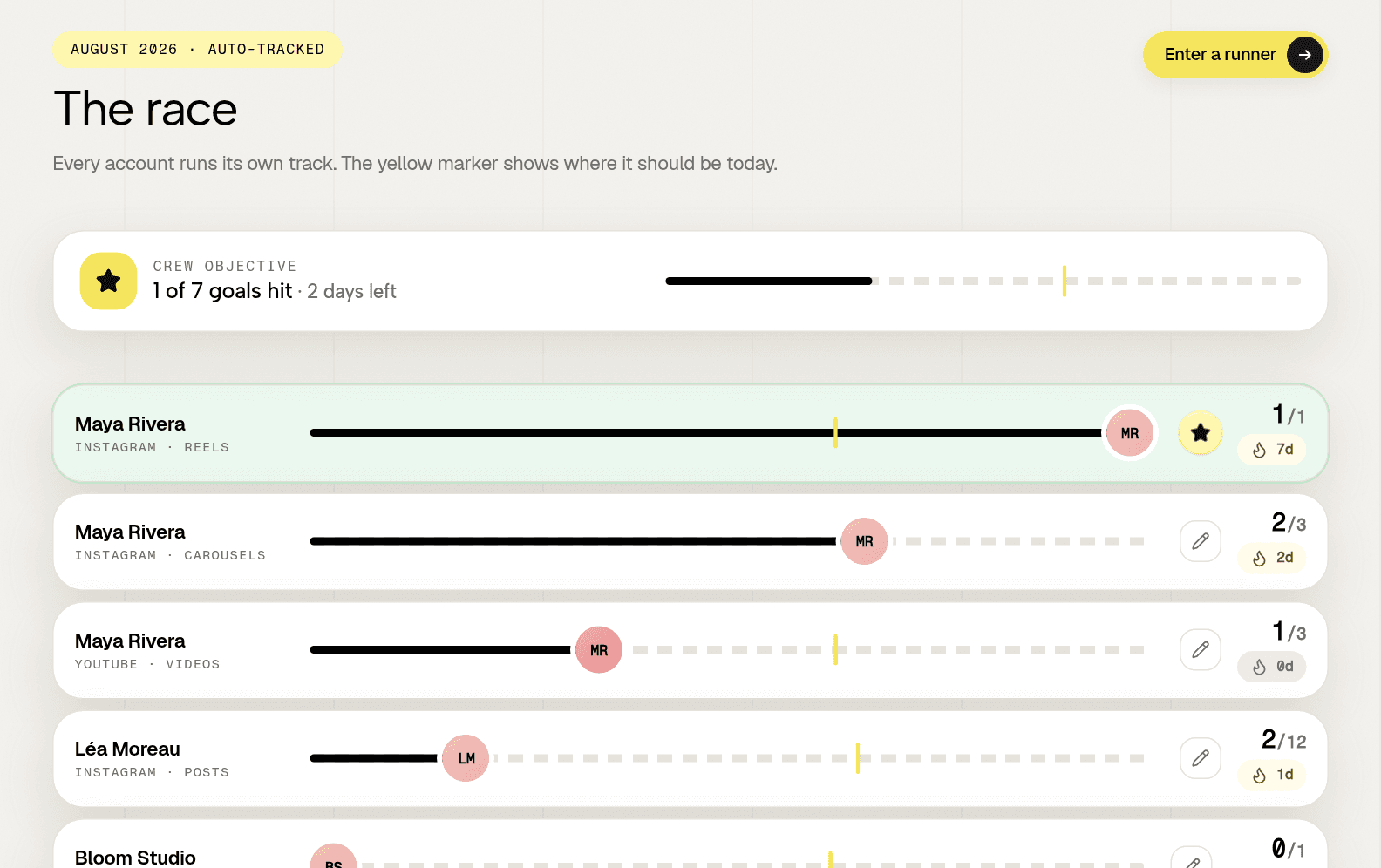
It never shows reach or impressions, because it cannot see them and a product that displays a number it cannot source is a product you cannot trust with the ones it can. It does not publish, schedule or answer comments either. Three accounts are free with no card, and the free audit reads one public profile without an account at all.
Frequently asked questions
How should you compare social media analytics tools?
By what each tool is allowed to read. Connected accounts give reach and audience data but only for accounts someone grants. Public profiles give posts, followers and engagement for anybody. Modelled numbers fill the rest and should always be labelled.
Can any tool show a competitor's reach?
No. Reach and impressions are given to the account owner, so any tool showing them for an account you do not own is estimating. Ask the vendor how the estimate is built before putting the figure in a client report.
What can you measure without connecting an account?
Posts published and when, follower counts and their trend, and the public likes and comments on each post. That is enough to answer cadence, growth and engagement questions for clients, prospects and competitors alike.