AgencyAnalytics alternative for the month you can still change
An automated report is a mirror. It shows a bad month perfectly, on the second, when nothing can be done.
The report is automated, branded, and goes out on the second of every month without anyone touching it. It is also, this month, a beautiful presentation of four posts where the contract said twelve. The dashboard did its job perfectly. Nobody found out in time to do anything about it.
This page is an AgencyAnalytics alternative for the case where the reporting is not the problem. It covers what white label reporting tools are for, why they sit downstream of the thing that actually goes wrong, and where the two fit together.
TL;DR
| Reporting dashboards | Groowth | |
|---|---|---|
| Job | Present what happened | Make it happen and count it |
| Data source | Connected channels | Public profiles |
| Covers ads, search, email | Yes | No |
| Works on an unconnected account | No | Yes |
| Unit | The channel | The person and their cadence |
| Tells you mid month | Rarely | Daily |
What white label reporting is built for
AgencyAnalytics is built around white label client reporting, pulling connected marketing channels into one branded dashboard, and the family around it does the same job in different wrappers, from automated slide decks to a spreadsheet connector. For an agency running paid media, search and email alongside social, that consolidation is genuinely valuable and nothing here replaces it.
Their promise is breadth and presentation: many connected channels, one branded artefact, sent automatically. It is a real saving, and it is a saving on the last mile.
Reporting is downstream of the thing that breaks
A report is a mirror. If the month went badly, it shows you a bad month, on the second, when the month is over. For paid media that is fine, because spend happened continuously and the levers are yours to pull.
Organic publishing by humans fails differently. It fails silently, in week three, when one person gets busy and stops. Nobody notices, because noticing requires someone to look, and the thing that makes people look is a report that arrives after it is too late.
A monthly report can only tell you about a month you can no longer change.
The pattern behind that is not an agency problem, it is how these programs die. It is set out in social media posting consistency.
The connected channel limit
Reporting dashboards pull from channels the client connects, which is right for ad accounts and analytics properties. It carries the same three limits everywhere in this market.
- A client who publishes personally. The founder posting under their own name will not connect their personal profile to your reporting stack.
- A prospect. Nothing to connect, so no report before the pitch.
- A competitor. Same, and a benchmark is often the most persuasive slide you have.
What is readable without any connection, and what is not, is mapped in public social media metrics.
What Groowth does instead
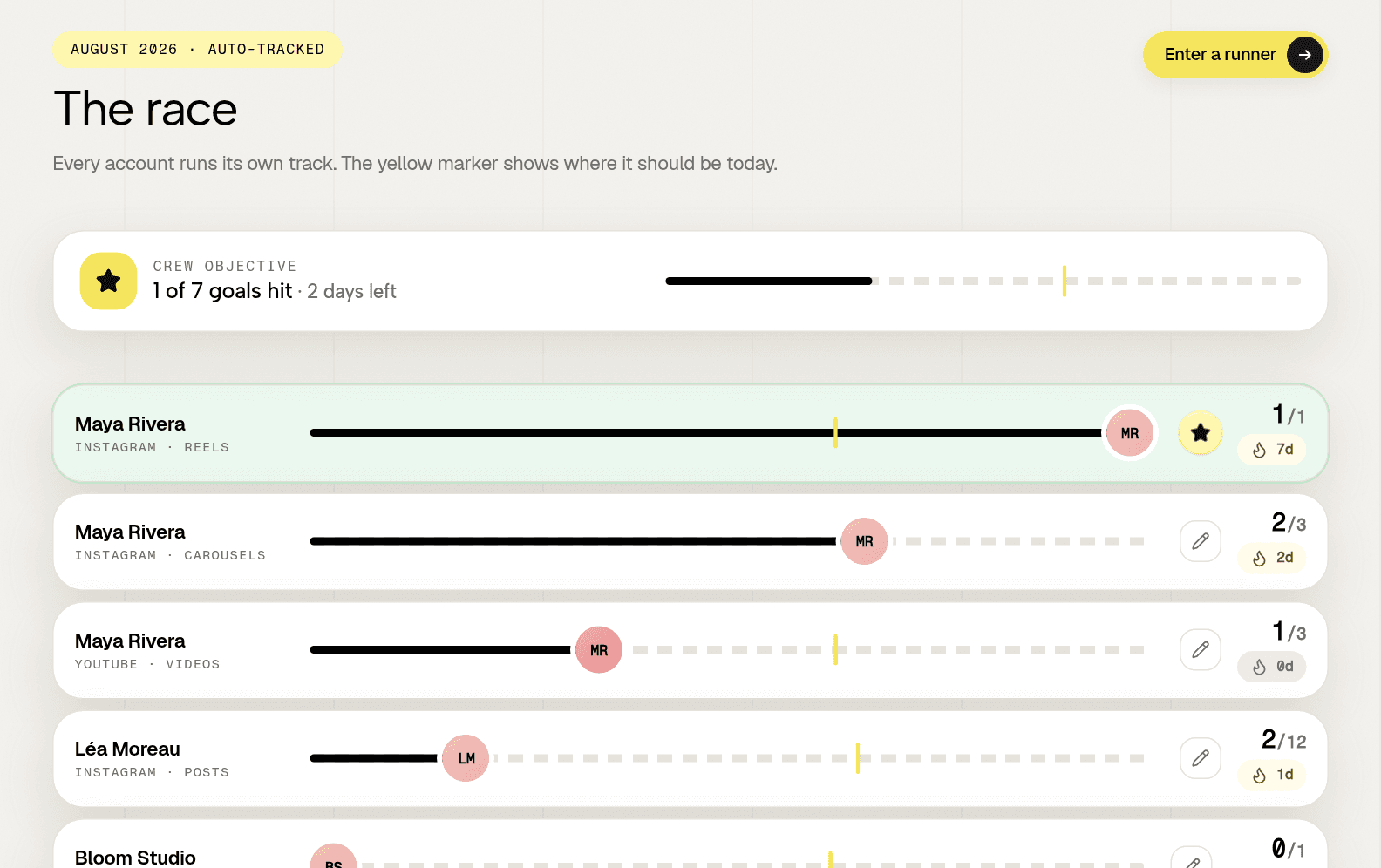
It watches the cadence daily rather than summarising it monthly. Each person has a goal they agreed, the posts detected on their public profile fill it, and a missed period is visible while the period is still running.
Reporting then stops being an artefact you assemble. The client gets a read only view of their own board, live, and the monthly note becomes five sentences of judgement instead of a deck proving work happened. That argument is in client reporting for personal branding.
What Groowth does not do
- No paid media, search or email. It is social publishing only, so it is not a consolidated marketing report.
- No connected channel integrations. Nothing pulls from an ad account or an analytics property.
- No reach or impressions. They need the owner's login, which it never asks for.
- No drag and drop report builder. PDF exports per account and per folder, with your logo on the agency plan.
If your monthly artefact has to carry ad spend next to organic, keep the reporting tool. The two do not compete for the same slot.
How to choose
- You report across paid, search, social and email. A reporting dashboard, and add cadence tracking beside it.
- Your only deliverable is organic publishing. Track the cadence and give the client the live view. The report was proving something they can now see themselves.
- Clients keep asking why a month was quiet. The fix is upstream: know in week two, not on the second.
- You pitch with benchmarks. You need public data on accounts nobody will connect. See track competitor social media.
Five clicks, no email. The verdict is this page's argument applied to your answers, and it says so when a reporting platform is the better buy.
Question 1 of 5What do you report on for clients?
Check the numbers at the source
No prices, plan names, integration counts or feature lists for AgencyAnalytics appear on this page. They change faster than a comparison page is maintained. The positioning above was last checked on 2026-08-21.
The mid month check that replaces a report
If a monthly report is the only moment anyone looks, the program is being managed once every thirty days. Replace it with two minutes on a Tuesday and most of the surprises disappear.
- Is anyone at zero? Someone with no post this period is the only genuine alarm, and it is visible on day eight.
- Is anyone behind the pace? Behind is not late. It is a nudge, this week, while there is time.
- Did a streak just break? The week after a break is when a program is actually lost.
- Is anything new to say to the client? If not, say nothing. A monthly note beats a weekly one nobody reads.
None of that fits in a report, because a report is an artefact and this is a habit. The artefact then becomes a summary of a month nobody was surprised by.
What a client actually reads
Automated reports get longer because length looks like value. What a client reads is four lines, and every one of them can come from public data.
| Line | Source | Needs a connection |
|---|---|---|
| Cadence held, per person | Public profiles | No |
| Audience added | Public follower counts | No |
| Median public engagement | Public posts | No |
| What changes next period | Your judgement | No |
The fourth line is the one they are paying for, and it is the only one no dashboard can generate. Everything above it exists to make that sentence credible.

How these programs actually fail
They do not collapse, they thin. One person stops in week three, another halves their rhythm, and the totals hold up for two months because the most prolific contributor is still going.
By the time a monthly chart bends, two people have been out for a quarter. A per person view catches it in week four, which is the difference between a conversation and a renewal problem.

What to keep from the reports you send today
Nothing here says stop reporting. It says the report was carrying two jobs, and only one of them belongs in a monthly artefact.
- Keep the paid and search consolidation. That is real work saved, and public data has nothing to say about it.
- Keep your branding. The artefact that leaves your hands should carry your name, not a vendor's.
- Move the organic proof into a live view. The client can check it whenever they want, which makes your note credible rather than defensive.
- Cut the slide that shows the best post. It sets an expectation no rhythm can meet, every month, forever.
What is left is shorter and it is read, which is a better outcome than a longer document that arrives on time and is scrolled past.
Automating a report makes a slow answer arrive on time. It does not make it arrive sooner.
That distinction is the whole page. Automation removed the assembly work, which was real and worth removing, and it left the timing exactly where it was: the second of the month, about a month that has finished. Everything an agency loses to a quiet client month happens before that date.
How Groowth handles this
One organisation per client, fully separated, with a read only seat for the client and PDF exports carrying your logo and colour on the agency plan. Adding an account is pasting a public link, so onboarding takes a call rather than three weeks of credential chasing.
Three tracked accounts free with no card, and a free audit that reads one public profile with no account at all, which is enough to build a benchmark slide before a pitch.
Frequently asked questions
Does Groowth replace an agency reporting tool?
No. Reporting dashboards consolidate connected channels including ads, search and email, which Groowth does not touch. It handles the upstream half: knowing during the month whether the publishing actually happened.
Why is a monthly report not enough for organic social?
Because it arrives after the month it describes. Paid media can be corrected continuously, but organic publishing fails silently in week three, and a report on the second is the first time anyone finds out.
Can reporting tools cover prospects and competitors?
Not through connected channels, which is what those tools use. Reading public profiles works on anyone, which is the only way to put a prospect or a competitor benchmark in a pitch.