Hootsuite vs Groowth: one posts, the other checks it happened
Written by one of the two, so the bias is declared first and the cases where the suite wins come before the ones where it does not.
Somebody has put these two on the same shortlist, which usually means the brief said track our social media and nobody asked what track meant. One of these products posts for you. The other watches whether posting happened, on accounts that will never be connected to anything. They are not competitors, and the shortlist is about to pick the wrong one.
A Hootsuite vs Groowth comparison, written by one of the two, so the bias is declared before the first table rather than buried: we make the second product. What follows is a division of labour, and the honest cases where the suite is the only right answer.
TL;DR
| Hootsuite | Groowth | |
|---|---|---|
| Built for | Publishing and inbox | Watching and cadence |
| Adding an account | Connect and authorise | Paste a public handle |
| Accounts you do not own | Impossible | Same as any other |
| Schedules posts | Yes | No |
| Answers comments | Yes | No |
| Shows reach | For connected accounts | Never |
| When a client leaves | Access and history go | History stays |
The bias, stated once
We build Groowth. A comparison written by a party to it is worth reading only if it is precise about where the other side wins, so that section is in the middle of this page rather than at the bottom, and it is longer than the section about us.
Hootsuite is built around scheduling, a unified inbox and paid social, across the accounts a customer connects to it. That is a real job, most agencies were hired to do it, and nothing on this page argues it is not worth paying for.
The line that separates them
A tool that writes to an account has to hold that account's keys. That is not a setup step, it is the architecture, and it decides permanently which accounts can ever appear.
Reading a public profile writes nothing, so it asks for nothing. The trade is explicit: no reach, no impressions, no audience breakdown, because those are given to the account owner. In exchange, an account you do not own behaves exactly like one you do.
Connection is the right architecture for writing and the wrong one for watching. Most frustration with a suite is that single mismatch.
When the suite is the only right answer
If any line below is part of your week, this comparison is already settled and it is not settled in our favour. Groowth does none of them and is not planning to.
- You publish for clients. No queue, no calendar, no drafts here. A tracker cannot ship a post.
- Comments and messages need answering. There is no inbox. None.
- Paid social sits in the same workflow. Nothing here touches ads.
- Reach per post is the contracted KPI. Only the account owner can grant that, and we do not ask for it.
- Audience demographics drive the strategy. Same answer, and no public reading gets close.
Five real disqualifications. If you are on a shortlist because somebody wants one tool for everything, the suite is that tool and this page has just saved you a demo.
Where the suite stops, and what falls out
Four situations come up in every agency and every founder-led programme, and none of them survives an architecture that needs a grant.
| Situation | Connected suite | Public reading |
|---|---|---|
| A prospect before the pitch | Nothing to connect | Paste the handle |
| A competitor | Never | Paste the handle |
| A founder posting personally | Usually refused | Paste the handle |
| A client who left | History goes | History stays |
That last row is the one nobody prices in during procurement. Eighteen months of reporting can live behind a connection that ends the day the retainer does.
The question a suite is not built to answer
Most programmes commit to a number of posts per person per week. No suite reports it, because a suite only sees what went out through the suite, and the founder posted from their phone at a conference.
Counting what was actually published, per named person, against what was agreed, needs public reading and nothing else. How to size that number in the first place is in posting cadence for teams.
Running both, and what that actually costs
Most agencies that publish for clients end up with both, and the split is clean rather than awkward: the suite holds the accounts you post from, tracking covers everything else.
The interesting part is not the second licence. It is that the two grow on different axes. A suite grows with the accounts you operate, which is bounded by what you sell. Tracking grows with the accounts you watch, which includes prospects and competitors and is therefore upside rather than delivery cost.
The sentence for the procurement form: the suite operates the accounts we publish from, tracking covers every account we do not, and the second set is most of what our clients ask about.
The first two weeks of a retainer
The difference nobody puts on a pricing page is what happens once the contract has started and the work has not, because somebody at the client has to grant access and they are travelling.
| Step | With connections | With public handles |
|---|---|---|
| Getting access | Chase logins and admin rights | Ask for profile links |
| Who has to act | The client, repeatedly | Anyone, once |
| Typical delay | One to three weeks | One call |
| Partial setup | Common, and it lingers | Not a state that exists |
| Somebody who refuses | Missing all year | Still covered if public |
The last row decides more programmes than any feature. There is always one person who will not add an agency to their personal profile, and with connections that person is simply absent from every report for the life of the contract.
The two bills grow on different axes
This is why running both is survivable at a small agency, and it is worth understanding before somebody objects to a second line item.
- A suite grows with accounts you operate. That number is bounded by how much publishing you sell, so it scales with revenue.
- Tracking grows with accounts you watch. That includes prospects and competitors, which are pure upside rather than delivery cost.
- Neither should grow with your team. Check that before signing anything priced per seat, on either side.
The practical effect is that adding a prospect to a watch list stops being a budget conversation, which is the difference between benchmarking three competitors before a pitch and doing it from memory.
One sentence for the procurement form
The suite operates the accounts we publish from, and tracking covers every account we do not, which is most of the ones our clients ask about.
It holds up because it is architectural rather than a preference between two products. No roadmap on either side changes which accounts can be connected, so the split will still be true when this page is out of date.
Check the numbers at the source
This page quotes no prices, plan names or feature lists for Hootsuite. Those move faster than any comparison is updated, and a stale figure about another company is worse than none. The positioning above was last checked on 2026-08-21.
The version of this argument written for somebody already paying for a suite and looking for a way out is a different page: Hootsuite alternative for agencies. This one is for a decision nobody has made yet. If you are weighing two suites against each other instead, that is Hootsuite vs Buffer.
What Groowth does, precisely
You paste public handles on TikTok, Instagram, YouTube and LinkedIn. It reads each profile once a day: what was published and when, the follower count, and the public likes and comments on each post. Then it counts that against the cadence each account agreed to hold, with streaks.
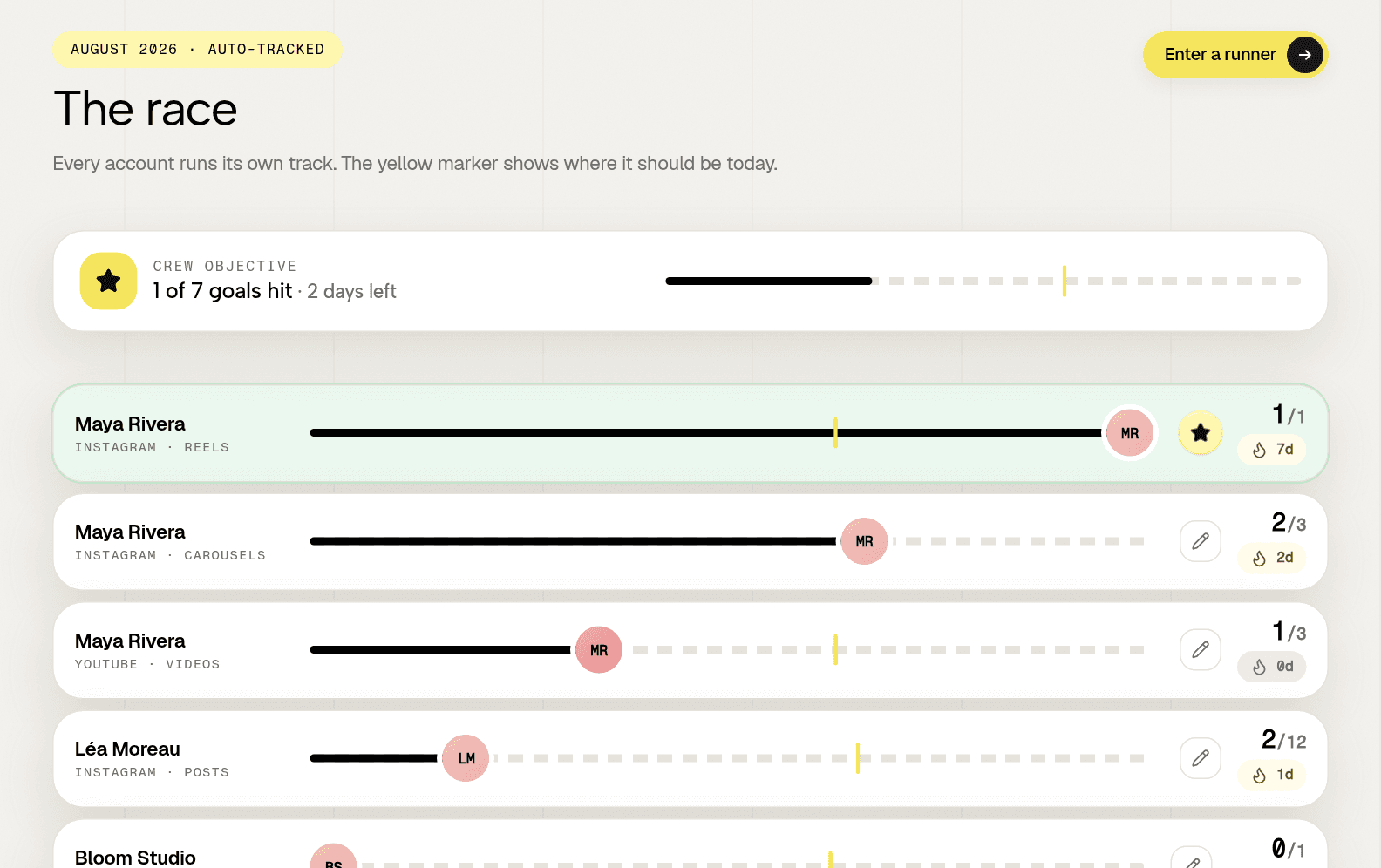
One organisation per client, fully separated, with a read only seat for the client. It never displays reach or impressions, because it cannot see them and a product that shows a number it cannot source is one you cannot trust with the numbers it can. Three accounts free with no card, and a free audit that reads one public profile with no account at all.
Frequently asked questions
Is Groowth a replacement for Hootsuite?
No, not for publishing. Groowth does not schedule posts, run an inbox or touch ads. It covers the watching half: what was published, by whom, against an agreed cadence, on accounts nobody connected.
Why can a suite not cover accounts you do not own?
Because a suite writes to the accounts it works with, so it must hold their keys. Reading a public profile writes nothing, which is why it works on a prospect, a competitor or a colleague posting under their own name.
What does Groowth not do?
Publishing, scheduling, moderation, paid social, reach per post and audience demographics. If any of those is part of the week, the suite is the right buy and a tracker cannot substitute for it.