Social selling, minus the sequence
Connect, pitch, follow up on Thursday. Here is the practice that works instead, and why no vendor sells it.
A connection request, then a pitch eleven minutes later, then a follow up on Thursday. That sequence is what most people mean by social selling, it converts at a rate somewhere near zero, and it burns the account it runs from. The practice that works looks almost nothing like it and is much harder to buy.
This is the complete guide to social selling: what it actually is, why the tooling points in the wrong direction, the reading half nobody automates, how to measure it without a vanity score, and where it stops being worth the time.
TL;DR
| Activity | Effort | What it produces |
|---|---|---|
| Automated connect and pitch | None | Reputation damage |
| Templated personalised opener | Low | Polite silence |
| Commenting on buyers' posts | Medium | Recognition, then replies |
| Publishing for the buyer | High | Inbound, slowly |
| Reading before writing | Medium | Everything above works |
| Buying a social selling score | None | A number nobody outside believes |
What social selling actually is
Social selling is using public social activity to earn a conversation with a specific buyer, rather than to reach an audience. That last clause is the whole distinction. Marketing on social is aimed at many people who are mostly strangers. Social selling is aimed at a named list, and the measure of success is a reply from somebody on it.
Because the list is named, everything scales badly and that is a feature. The activities that work are the ones that cannot be done to two thousand people at once, which is precisely why the software category has drifted toward the ones that can.
It is also worth saying what it is not. It is not cold outreach with a friendlier opening line, and it is not content marketing with a sales title. It sits between them and it borrows the failure modes of both when it is done carelessly.
If the activity can be run against two thousand people this afternoon, it is not social selling. It is cold outreach with a better logo on the tool.
Why the tooling points the wrong way
Sales software is priced per seat and justified by volume, so it optimises the parts of the job that produce volume. Those are sending and sequencing. The parts that actually move a deal are noticing and reading, and neither of those generates a metric a tool can put on a dashboard. A vendor cannot demonstrate attention, so the demo shows throughput instead, and throughput is what gets bought.
The result is a category where the default configuration does the harmful thing well. Automated connection requests at scale, identical openers, follow ups on a timer. It works often enough to be measurable and rarely enough to be worthless, and the cost is paid by the account rather than by the tool.
- Volume is measured, damage is not. Nobody reports the number of buyers who now ignore your name on sight.
- Personalisation tokens are visible. A first name in a template reads as a template, and a wrong company name reads as contempt.
- Automation gets accounts restricted. Networks act against connection request volume, and the restriction lands on the person, not the vendor.
- The score is internal. A social selling index moves when you use the product more. Buyers cannot see it and it predicts nothing.
None of this means avoid tools. It means the tool should be helping you read and remember, not helping you send. That is an unusual thing to buy and it is worth knowing that before a demo.
The reading half, which nobody automates
The difference between an opener that gets a reply and one that gets ignored is almost always information, and the information is public. What the person published, what they reacted to, what their company announced, who else in their world is talking about the same problem. None of it is hidden and almost nobody bothers to look.
This is unglamorous and it is the job. Half an hour a day of reading produces more usable openings than any volume of sending, and it compounds, because the second time you comment on somebody's post they recognise the name.
- Read their last ten posts before writing anything. It takes four minutes and it is the difference between a specific sentence and a generic one.
- Watch what they react to, not only what they publish. People comment on the problems they have and publish about the ones they have solved.
- Track the company's own account separately. A launch, a hire or a funding round changes what the person cares about this month.
- Write down what you learn. A note per account beats a memory, and it survives a holiday and a handover.
The mechanics of reading a profile's history, including what a network will and will not show you about somebody else's posting, are in how to see someone's LinkedIn post history.
The order of operations
There is a sequence that works and it is almost the reverse of the one the tools encourage. It is slower to start and it does not stall in the same way, because each step earns the right to the next one.
- Follow, do not connect. Following is free, invisible and unlimited. A connection request is a small ask and it should be spent later.
- Comment three times over three weeks. Substantive comments, on posts you actually read. This is the entire trust building phase and it costs nothing.
- Publish something they would find useful. Not about your product. About the problem they keep commenting on.
- Then connect, with a reason. By now the name is familiar, and the request reads as continuity rather than as an approach.
- Only then, ask for the conversation. And ask for a conversation, not a demo.
The uncomfortable part is that the whole sequence takes about a month per account and it does not compress. What compresses is the number of accounts you can hold at once, which is the real capacity limit of the practice and is usually somewhere between thirty and sixty.
The list, and why most of them are too long
Everything in this practice depends on a list of named accounts, and the most common way it fails is that the list has four hundred names on it. A list that cannot be read weekly is not a list, it is a database, and it will be treated as one within a fortnight.
The working size is the number of accounts one person can genuinely keep in their head, which is somewhere between thirty and sixty depending on how active those accounts are. Beyond that the reading becomes skimming, the comments become generic, and the whole advantage evaporates.
- Start from closed deals, not from a filter. Look at who actually bought, then find the twenty accounts that resemble them. A firmographic filter produces a list nobody believes in.
- Require activity. An account that has posted twice in a year cannot be engaged with, whatever its title says. Check before adding, not after three silent weeks.
- Include the company account and one colleague. Buying decisions are rarely made alone, and the second person is usually easier to reach than the first.
- Drop ruthlessly, every month. A name that has produced nothing in three months is occupying a slot that a live account could use.
The monthly drop is the discipline that keeps the practice honest, and it is the one nobody does. A list only ever grows unless somebody has explicit permission to shrink it, and a list that only grows becomes a spreadsheet nobody opens.
The ratios that say it is working
Because outcomes lag, the useful early signals are ratios between things you did rather than counts of things that happened. Three of them separate a practice that is compounding from one that is going through motions.
| Ratio | Healthy | What a bad number means |
|---|---|---|
| Comments left to messages sent | Three to one or better | You are doing outreach, not selling socially |
| Accounts read to accounts on the list | Most of them, weekly | The list is too long |
| Replies to connection requests | Rising over months | The earlier steps are being skipped |
The first ratio is the diagnostic one. A team whose messages outnumber its comments has quietly reverted to the sequence, usually because a quarter ended and somebody needed a number. It is worth reviewing monthly for exactly that reason.
Measuring it without a vanity score
Social selling has an unusually bad measurement culture, mostly because the platforms supply a proprietary score that is easy to quote and means nothing outside the platform. The honest measures are duller and they work.
| Measure | Why it works | Where it comes from |
|---|---|---|
| Accounts you read this week | The leading indicator | Your own log |
| Comments left on target accounts | Recognition, before reply | Public, countable |
| Replies from named accounts | The actual output | Your inbox |
| Posts published by you | Whether the inbound half exists | Public |
| A platform selling score | It measures product usage | Ignore it |
The first two rows are the ones to defend in a weekly review, because they are the only ones a person controls. Replies are an outcome and outcomes lag by weeks, so a team judged on replies in month one will abandon the practice in month two. Publishing cadence is the other half, and how much of it is enough is covered in how often to post on LinkedIn.
One more thing belongs in the log, and it is the one people leave out because it feels like admitting failure. Record the accounts you dropped and why. Six months later that column is the only honest evidence of whether the list was built well, and it is what stops the same unreachable account being added again by somebody new.
Everything here is countable without a licence. A shared sheet with a row per account per week does the job, and the reason to eventually replace it is not features but decay: a log filled in by the person being measured has a hole in the busy month, which is precisely the month worth looking at.
The publishing half, and who should do it
Reading earns individual conversations. Publishing is what makes those conversations easier every month, because a buyer who has seen your name in their feed for a quarter answers differently from one who has not.
The mistake is to treat this as the marketing team's job delegated to sales. Posts written by a marketing team and published under a salesperson's name are detectable, and the detection costs more than the post earns. What works is raw material from marketing and words from the person.
- Write about the objection you heard twice this week. It is specific, it is current, and it is the thing your buyers are actually arguing about internally.
- Answer a question you were asked in a call. The answer already exists and it is already good, because you gave it out loud to somebody who cared.
- Never publish a case study as a post. The format announces itself and the audience skips it.
- Post less than you think and comment more. Comments reach the exact people you want and cost a tenth of the effort.
When several people in a company do this at once it stops being social selling and becomes something wider, with different measurement and different failure modes. That practice is covered in employee advocacy, and its founder shaped version in founder led marketing.
When social selling is the wrong instrument
It is a slow, high effort, low volume practice with a capacity ceiling of a few dozen accounts per person. There are markets where that maths simply does not work, and it is cheaper to know that in week one.
- Very low deal value. If a closed deal is worth a few hundred, a month of attention per account cannot be recovered at any conversion rate.
- Buyers who are not on social. Some roles and some industries genuinely are not there. Check twenty real accounts before committing a quarter.
- A very large addressable market with a short cycle. Volume channels win, and social selling is a rounding error against them.
- No willingness to publish. The reading half alone still works, but at roughly half the effect and with a much longer ramp.
Where it does work, it works because the alternative channels are saturated and this one cannot be. Nobody can automate reading somebody's last ten posts, which is exactly why the advantage lasts. Every other channel gets more expensive as competitors adopt it, and this one gets more valuable, because the pool of people willing to do unautomatable work does not grow.
How Groowth fits into this
Groowth is on the reading side. You paste the public handles of the accounts on your list, buyers and their companies, and it records what each of them published and when, their follower count, and the public reactions on each post. Nothing is connected, no request is sent, and nobody is contacted.
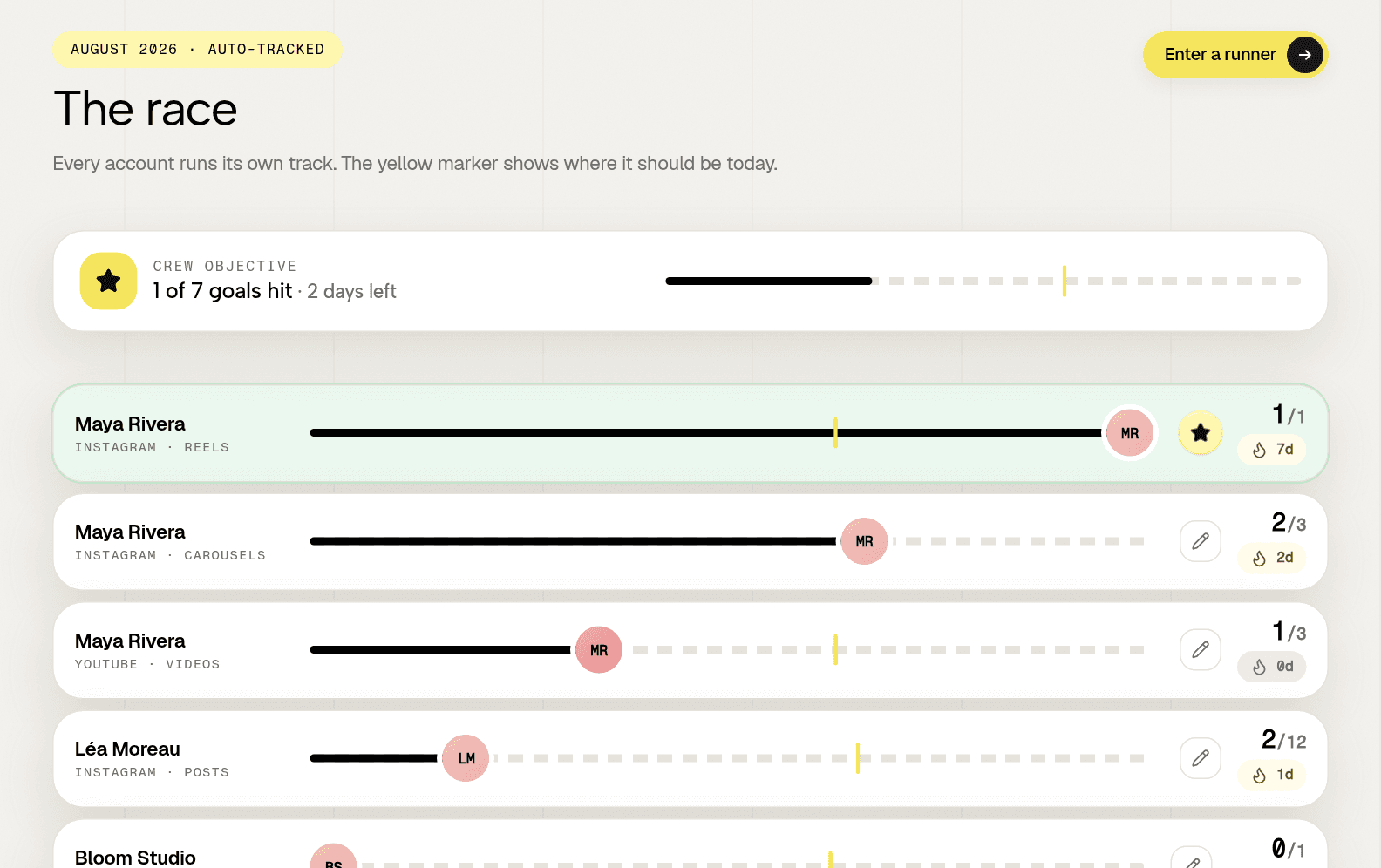
It sends nothing and it never will, which makes it useless for volume outreach and useful for the half of the job that decides whether the outreach lands. The same board holds competitors, which is the other set of accounts worth reading weekly, described in tracking competitor social media. Three accounts are free with no card.
Frequently asked questions
What is social selling?
It is using public social activity to earn a conversation with a named buyer, rather than to reach an audience. The measure of success is a reply from somebody on your list, which is why it scales badly and why that is a feature.
Why does automated social selling fail?
Automated connection requests and templated openers produce volume that is easy to measure and reputation damage that is not. Networks also act against request volume, and the restriction lands on the person rather than on the vendor.
How do you measure social selling?
Count accounts read and comments left on target accounts weekly, because those are the parts a person controls. Replies are an outcome and lag by weeks. A platform supplied selling score measures product usage and predicts nothing.